
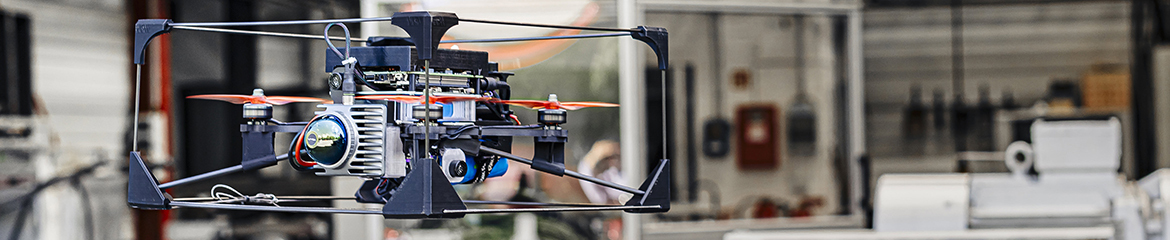
We have various research drones that we design and build ourselves. These custom-built drones are continuously improved and modified. Depending on the task, we equip them with different cameras and sensors.
In our research projects, we investigate among other things, how drones can fly semi-autonomously indoors and be used to monitor the surroundings in intralogistics.
Research drone for LiDAR and a 180-degree fisheye camera
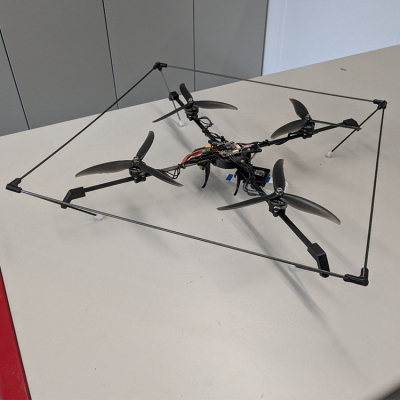
This custom-built drone is designed to carry a LiDAR sensor and a 180-degree fisheye camera. It is intented to fly ahead of forklift trucks to detect people and other vehicles in an early stage. A protective frame helps shield the drone from collisions.
The drone is used in the MouSe research project.
Research drone with a payload capacity of up to 1.5 kilogram
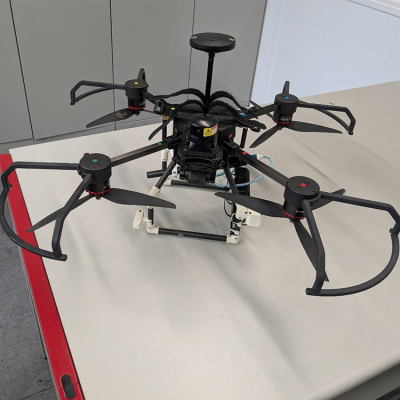
This drone was built specifically for IPH as versatile platform for payloads of up to 1.5 kilograms, such as measurement microphones.
It features 360-degree environmental sensing, GPS and can also be used indoors.
Research drone for load transfer at transfer stations
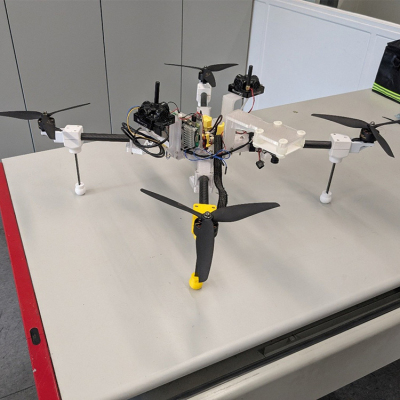
This custom-built drone is designed to dynamically place load carriers at dedicated transfer stations.
It also features a camera for detecting markers and beacons for an indoor positioning system.
Research drone for autonomous exploration
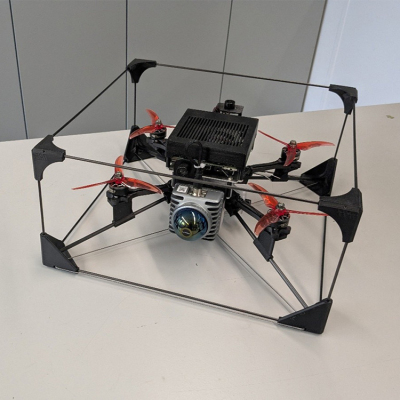
This drone was developed at IPH to explore unknown environments fully autonomously.
It features a Livox Mid360 LiDAR sensor, ultrasonic sensors and a powerful mini PC. A robust carbon-fibre reinforced nylon cage helps protect the drone against collisions and falls.
The drone was developed as part of the AIMS5.0 research project.
Research drone with an extended flight time
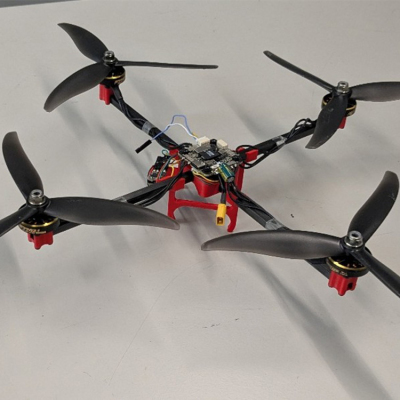
This drone was developed to achieve the longest possible flight time. It weighs approximately 300 grams including the battery and can remain airborne for over 45 minutes.
Equipped with a camera, it is intended for image capture and mapping in the SemaFact research project.
Research drone for semi-autonomous indoor flight
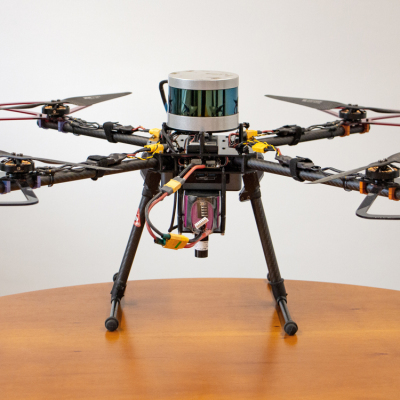
This custom-built drone weighs approximately 4.5 kilograms including the battery, camera and laser scanner. It can carry additional equipment weighing up to 3 kilograms, such as extra cameras.
Developed as part of the Autodrone research project, the drone is able to fly semi-autonomously indoors. For navigation in environments without GPS reception, it uses a downward-facing camera and a laser range finder.


