| Theme | Automated guided vehicles, Artificial Intelligence, Industry 4.0 |
|---|---|
| Project title | Mobile human-computer interaction for commissioning and controlling of automated guided vehicles (MobiMMI) |
| Project duration | 01.07.2018 – 30.07.2020 |
| Video | |
| Download | |
| Press release |
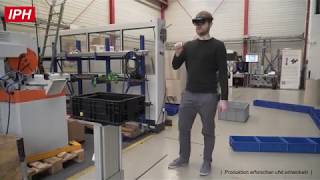
The operation of unsteady conveyors is currently done manually e.g. with forklift trucks or fully automated with automated transport vehicles (AGV). Compared to manual unsteady conveyors, AGVs are characterized by a lower accident rate, faster processing of orders and a reduced wear due to incorrect operation. They make a decisive contribution to lower operating costs for SMEs.
The disadvantage of using AGVs is its behavior in critical operating situations such as e.g. the storage at undefined plate positions. While the operator of a forklift truck can react individually to these situations, it is not possible for an AGV to solve these situations independently.
The goal of this research project was the development of a mobile system for speech- and gesture-based human-computer interaction to enable intervention in critical operating situations. In this way, the more economical operation of an AGV can be used while avoiding unwanted behavior.
Publications about the project
Automated guided vehicles are a crucial component for more efficient production systems in intralogistics, but they have weaknesses in human-machine interaction. Scientists at IPH are developing a gesture-based control system to make the interaction intuitive and increase its acceptance.
Driverless transport vehicles, guidance control, gesture-based control
This article shows how the abilities known to humans to be flexible and adapt to changing environmental conditions, which are reflected in human cognitive characteristics, can be transferred to industrial trucks in intralogistics. As examples for the implementation of Industry 4.0 in intralogistics, technologies are presented that enable industrial trucks to recognize their environment, communicate information, draw conclusions, act autonomously, make decisions, learn or plan. These capabilities will be realized by an optical positioning system for position determination, camera-based storage/retrieval support and sensor technology integrated into tires, as well as novel forms of interaction for industrial trucks in the form of speech and gestures.
automated guided vehicle, augmented reality, smart glasses
Driverless transport systems are a building block for more efficient production systems in intralogistics, but have weaknesses in human-machine interaction. In a complex research project, a voice-based assignment is being developed, among other things, which is intended to make human-machine interaction more intuitive and increase its acceptance.
automated guided vehicle, augmented reality, smart glasses, voice control