| Theme | Process design, Forming technology, Industry 4.0, Artificial Intelligence |
|---|---|
| Project title | Design of efficient forging sequences with mass distribution around the center of gravity line for forging parts (Effiziente Stadienplanung) |
| Project duration | 01.11.2017 – 31.01.2021 |
| Video | |
| Download | |
| Press release |
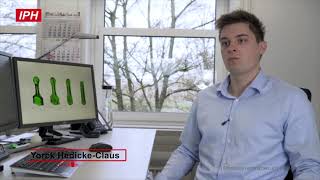
To increase the economic efficiency in the production of geometrically complicated forgings, material efficiency is a determining factor. For a high degree of material utilization, the preforms are decisive, which can be designed using efficient planning of process chains and preform geometries.
The aim of the project is to develop a universal method for process-reliable planning of multi staged forging sequences for forgings of all kinds. Based on a CAD geometry, the method should determine the resulting center of gravity line (3D) and mass distribution of the workpiece. Starting from the finished forging, the mass distribution is to be approximated to the mass distribution of the bar stock. The method considers forming rules in order to develop the forging sequence.
This method saves enterprises time in the development of the forging sequence. Furthermore, it is possible to increase the material efficiency in the production process by using the method.
Publications about the project
The development process for designing die sequences in drop forging is an experience-dependent and time-consuming process. Due to the high competitive pressure, small and medium-sized companies in the forging industry in particular often do not have the capacity for a detailed design of efficient and optimized stage sequences. In this thesis, a method was developed for the automated design of multi-stage die forging sequences based on component geometry. The developed method consists of individual modules that gradually determine the necessary parameters (mold class, complexity of the forged part, number of steps, burr proportion) for the design of a stage sequence from the component geometry and generate the individual intermediate forms of the stage sequence. The application of the method to various component geometries has shown that stage sequences can be generated automatically for a wide range of forged components (long forms, disk forms, squat forms, curved long forms, long forms with forks). Forming-related boundary conditions such as volume constancy and permissible changes in length are adhered to. FEM simulations were used to check the quality criteria of mold filling and freedom from wrinkles, demonstrating that the method generates process-reliable stage sequences.
Forging, CAD, stage planning, automated process design
Forgings are produced in several process steps, the so-called forging sequence. The design of efficient forging sequences is a very complex and iterative development process. In order to automate this process and to reduce the development time, a method is presented here, which automatically generates multi-stage forging sequences for different forging geometries on the basis of the component geometry (STL file). The method was developed for closed die forging. The individual modules of this forging sequence design method (FSD method) as well as the functioning of the algorithm for the generation of the intermediate forms are presented. The method is applied to different forgings with different geometrical characteristics. The generated forging sequences are checked with FE simulations for the quality criteria form filling and freedom from folds. The simulation results show that the developed FSD method provides good approximate solutions for an initial design of forging sequences for closed die forging in a short time.
forging sequence, forging sequence planning, automation
Reducing the planning and development time for efficient staging sequences in closed die forging offers companies in the forging industry a high potential for responding to competitive to respond to competitive challenges and remain competitive.The digitization of development processes opens up innovative support options for companies.
forging sequence desing, forming technology, digitization, process development, CAD