| Theme | Tool- and Mold-Making, Forming technology |
|---|---|
| Project title | Process combination of cross-wedge rolling and multi-directional forging (ProKomb) |
| Project duration | 01.06.2014 – 30.05.2016 |
| Video | |
| Results | |
| Download |
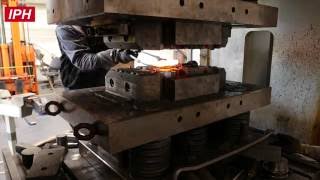
To optimize the potential of preforming operations, which was the aim of this research project, the influence of cross wedge rolling on multi-directional forging was investigated. Initial situation is a four step forging process for a flashless crankshaft with pin and flange. This process consists of cross wedge rolling, lateral extrusion, multi-directional forging and final forging. In this research project many different FEA simulations were executed; each one with another parameter combination. Examples for the parameters are forming angle, diameter reduction and offset of the axis. The results show several possible parameter combinations as well as the process limits of a parameter field that avoids flash and folds. Beyond this, the intensity of each parameter was shown.
Publications about the project
To determine the influence of the process combination of cross wedge rolling with multidirectional forming on the burr formation in single-cylinder crankshaft preforms, cross wedge rolling and multidirectional forming geometries were determined. For this purpose, FEM simulations were first used to narrow down the value range of the five varied parameters for subsequent experimental investigations.
The parameters were the shoulder angle, the reduction in cross-sectional area, the bearing offset, the forming speed and the workpiece temperature. After the evaluation of both investigations, there was potential for adjustments to the FEM simulations. In the course of the search for suitable parameters for adaptation, friction was identified as significant in the FEM simulations.
On the one hand, the values were varied within the friction coefficient friction factor model used; on the other hand, the suitability of another friction model, the IFUM friction model, was examined.The latter influenced the results of the FEM simulations in such a way that a sufficient approximation to the experimental investigations was achieved and a mathematical model could be formed on this basis.
cross wedge rolling, multidirectional forming, crankshaft, friction
To forge a flashless crankshaft within few steps and with low energy consumption innovative forging processes are necessary, such as cross wedge rolling and multi-directional forging. The direct combination of the two forming processes normally leads to flash at the bottom of the crankweb preform after the multi-directional forging. The reason for the flash generation is the rotation-symmetric cross wedge rolled billet, which is formed laterally to the main axis during multi-directional forging. In this paper, a parameter field in which flashless crankshaft preforms can be forged is presented. The parameters varied within the experimental research are the forming angle and the cross section area reduction at cross wedge rolling as well as the axis offset, the billet temperature and the forming velocity at the multi-directional forging. The limits of this flashless parameter field are shown in several diagrams. For a flashless combination of two forming process low values for all parameters such as a forming angle of 30°, a cross section area reduction of 30 %, and a billet temperature of 1050 °C are recommended. Furthermore, the intensity of the influence of the significant parameters are shown. The cross section area reduction thereby caused the highest range at flash generation with 0.4 mm.
multi-directional forging, cross wedge rolling, crankshaft, parameter study, flashless
A low energy demand and a fast processing time are required in each industrial process for the production of crankshafts. Crankshafts have a very complex geometry and are forged with a high percentage of flash compared to other forging parts. Recent research showed the feasibility of a flashless forging of crankshafts. One way to forge a flashless crankshaft within three steps is to use cross wedge rolling, multi-directional forging and final forging.
This paper presents the investigation results of the influence of the cross section area reduction in cross wedge rolling on different parameters at multi-directional forging. First, the state of research, the process development and tool design of cross wedge rolling and multi-directional forging are described. Then a parameter study will be presented and the influence of the cross section area reduction on flash generation, billet temperatures, forming degree, forming forces and effective strain are shown. Generally, flash generates because a rotation-symmetric billet is forced into an asymmetric movement. The influence of an increasing cross section area reduction leads to a decreasing amount of flash at the bottom of the crankwebs.
multi-directional forging, cross wedge rolling, crankshaft, parameter study, forming angle