| Theme | Forming technology, Process monitoring |
|---|---|
| Project title | Incremental forming of hybrid parts using cross-wedge rolling (SFB 1153 – Teilprojekt B1 – Querkeilwalzen) |
| Project duration | 01.07.2015 – 30.06.2027 |
| Video | |
| Project website | www.sfb1153.uni-hannover.de |
| Results | |
| Download | |
| Podcast |
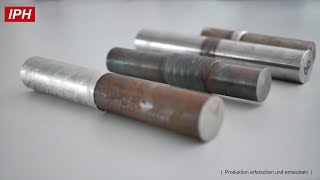
The overall objective of the collaborative research centre "Tailored Forming" is to open up the potential for hybrid solid components based on a new tailored manufacturing process using semi-finished products assembled. Unlike existing manufacturing and production processes of hybrid solid components in which the joining process takes place only during the forming operation or at the end of the production chain, tailor-made semi-finished products are used in the collaborate research centre, which are added before the forming process. Compared to the existing production process the simple geometry of the semi-finished products facilitates the handling and the reliable production of a material joining zone. In the subproject B1 the incremental forming of hybrid semi-finished products by cross wedge rolling is investigated.
- Sorry, no events available.
Vergangene Termine gefunden
- 23.07.2015
- PZH – Produktionstechnisches Zentrum Hannover, An der Universität 2, 30823 Garbsen
- 26.11.2015
- PZH – Produktionstechnisches Zentrum Hannover, An der Universität 2, 30823 Garbsen
- 01.02.2016
- PZH – Produktionstechnisches Zentrum Hannover, An der Universität 2, 30823 Garbsen
- 25.04.2016
- PZH – Produktionstechnisches Zentrum Hannover, An der Universität 2, 30823 Garbsen
- 27.06.2016
- PZH – Produktionstechnisches Zentrum Hannover, An der Universität 2, 30823 Garbsen
- 07.11.2016
- PZH – Produktionstechnisches Zentrum Hannover, An der Universität 2, 30823 Garbsen
Publications about the project
The Collaborative Research Center 1153 “Tailored Forming” is researching novel process chains for the production of hybrid solid components. The targeted use of different materials in a component can significantly reduce both resource consumption and energy requirements. However, process fluctuations from upstream joining processes can lead to component failure in the cross-wedge rolling process. The aim of this work is therefore to develop real-time, artificial intelligence (AI)-based process monitoring for the detection and classification of such deviations in the ongoing transverse wedge rolling process. The detected process fluctuations are to serve as the basis for predictive process control. Inline sensor data is used to develop the AI models. Various AI methods were used to investigate whether the requirements for real-time capability, classification accuracy, and low data volumes were met. Instance-based methods and decision trees delivered the best results, with up to 100% accuracy in anomaly detection and 86% in classification. The deep learning method autoencoder successfully complemented the range of methods, while statistical learning methods and other deep learning approaches were less suitable. It was shown that reliable detection of deviations is possible within the first two seconds of the process. The methods developed are transferable to other tailored forming processes and form the basis for future process-integrated control in industrial environments.
Artificial intelligence, tailored forming, process monitoring, cross-wedge rolling
Industrial process monitoring has a significant impact on ensuring quality and efficiency, particularly in complex manufacturing processes such as cross-wedge rolling. This study evaluates the performance of four deep learning approaches—Artificial Neural Networks (ANN), Convolutional Neural Networks (1D-CNN), Autoencoders, and Recurrent Neural Networks (RNN) using Long Short-Term Memory (LSTM)—for detecting deviations during the cross-wedge rolling of hybrid workpieces. Given the challenge of a small dataset, data augmentation techniques are applied to enhance model training. The investigation aims to determine whether deep learning can effectively classify process deviations and which architecture performs best. The results indicate that 1D-CNN models achieve the highest classification accuracy within the test group. Additionally, various hyperparameters are analyzed to identify those with the most significant impact on model performance. The findings contribute to the optimization of deep learning-based process monitoring, highlighting the potential of 1D-CNN and Autoencoder models for industrial applications.
deep learning process monitoring Cross-wedge rolling
Process monitoring and the resulting increase in quality through AI are attracting increasing attention in large parts of the manufacturing industry. The possibilities of inline process monitoring of cross-wedge rolling are being investigated as part of the research of the Collaborative Research Center 1153. The aim is to develop a monitoring system that enables inline process control in order to compensate process deviations that occur during the forming process. Therefore, an algorithm is developed that can detect and classify process deviations within a few seconds and while the process is still running. An AI-based image recognition algorithm was applied as part of this research work. The process data was collected as part of a sensitivity study of the process parameters. A parameter study was used to determine optimized hyperparameters for AI modeling that enable a high prediction accuracy. The challenge of the necessary speed of the prediction was tested and validated. The evaluation of the algorithm including the generation of a picture requires 270 ms on average and is therefore fast enough to be used as preparation for process control. The investigations revealed a possibility for data augmentation that significantly increases the predictive accuracy of the models. Leave-One-Out Cross-Validation (LOOCV) was used to conclude the overall performance of the model.
Cross-wedge rolling, Hybrid components, Process monitoring, AI-based image recognition